

It Takes a Village
When people talk about “support networks,” it can sound like something you should have already sorted before your baby arrives, a ready-made village, full of capable adults who always answer their phones and definitely don’t panic when the baby cries.
Most parents quietly discover that their “village” feels a lot less impressive than that. Sometimes it’s one friend who checks in, a family member who lives a bit too far away, or a professional you only see once a month but who feels safe and steady. That still counts. A support network isn’t about size or perfection. It’s about knowing that when things feel uncertain, you’re not completely on your own.
And that matters more than we often realise — especially in the first 1,001 days.
Why the First 1,001 Days Matter
The first 1,001 days, from pregnancy to a child’s second birthday, are now recognised nationally as a critical window for a baby’s development. During this time, a baby’s brain is growing faster than at any other point in life. The everyday moments of care, connection, and responsiveness they experience during this period literally shape how their brain wires itself for the future.
That’s why early relationships are so important. Babies learn how safe the world is, how to regulate their feelings, and how to communicate by being met, noticed, and responded to by the adults around them. The Best Start for Life framework is built on this understanding. It highlights that supporting parents early isn’t just a “nice extra”, it’s essential to giving babies the strongest possible emotional and developmental foundations.
When parents feel supported, they are more able to be emotionally available for their baby. And when babies experience that steady, responsive care, it sets the groundwork for their long-term wellbeing, learning, and resilience.
 Parenting Was Never Meant to Be a Solo Sport
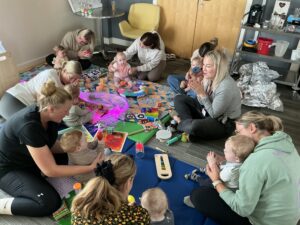
The reality is that parenting a baby can feel surprisingly lonely. Even when you’re surrounded by people, it can feel like the responsibility is all yours. You are the one waking in the night, reading your baby’s cues, and figuring out what they need from moment to moment.
That’s why having someone to talk to, or somewhere you can go, makes such a difference. It can shift how you feel about yourself as a parent, and how connected you feel to your baby. The chance to share worries, ask questions, or simply sit with other parents who “get it” can bring a sense of relief that’s hard to put into words.
Research from the Parent-Infant Foundation and the Harvard Center on the Developing Child shows that when parents feel emotionally and practically supported, they are more able to build secure relationships with their babies. That’s one of the strongest protective factors for a child’s development.
So yes, the village matters. Even if it’s small, growing, or still taking shape.
 Why This Is Bigger Than One Family
The work of building support networks isn’t only about individual parents. It’s about the wider community.
When families feel connected, understood, and able to access early guidance, the benefits ripple outwards. Children arrive at nursery and school more emotionally ready to learn. Parents feel more confident and less isolated. Services are less stretched because families are getting what they need earlier, before things reach crisis point.
The Best Start for Life agenda talks about giving every child the chance to thrive. But thriving babies don’t exist in isolation. They are part of families, workplaces, neighbourhoods, and communities. Strengthening the earliest relationships strengthens the whole system around them.
That’s one of the reasons we want our community to grow and prosper. When we invest in parents and babies, we’re not only supporting one family — we’re investing in the future social and emotional wellbeing of the place we all share.
The Takeaway
Your support network doesn’t have to be big or perfect. It just has to be there. Someone to turn to. Somewhere that feels safe. A moment of connection in an otherwise very full and very tired day. And when babies get a good enough start, communities grow stronger — one relationship at a time.
