

What a major new Swedish study tells us about the true cost of waiting and the opportunity we have to act sooner
Every early years professional knows, in their bones, that the earliest relationships shape everything that follows. At Good Enough Start, this belief sits at the heart of our work: the period from conception to age two (the first 1001 days) is where the foundations of lifelong emotional wellbeing are laid, largely through the quality of the parent-infant relationship.
New research out of Sweden gives us something we don’t often get in this field: hard numbers that back up what practitioners have long known intuitively. A large longitudinal study published this year in Child and Adolescent Psychiatry and Mental Health followed nearly 7,000 preschool children in the Uppsala Region and tracked their healthcare use over four years. The findings are a powerful case for early, relationship-focused support and a timely reminder of why the work done in the first 1001 days matters so much.
What the study found
Researchers used the Strengths and Difficulties Questionnaire, completed by mothers, fathers and preschool teachers, to identify children showing early signs of mental health difficulties at ages 3, 4 and 5. They then linked this to Sweden’s national health registers to see what happened next.
The results were striking. Compared with closely matched peers, children flagged with early difficulties went on to have:
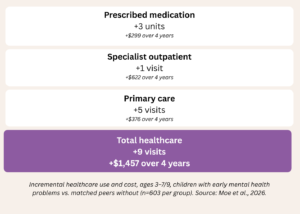
Perhaps most notable of all: these differences were visible from age three — years before most formal mental health services ever get involved. And the pattern held true no matter who did the rating, mothers, fathers or nursery/preschool staff all identified the same children, and all predicted the same elevated use of healthcare down the line.
It would be easy to read a study like this and hear only the difficulties, the diagnoses, the costs, the extra appointments. But look again, and there’s a genuinely hopeful message underneath the numbers.
The researchers describe the preschool years as a “window of opportunity.” If differences in wellbeing are visible — and measurable — from age three, that means there is real, actionable time to intervene before patterns become entrenched. This isn’t a story about children who are already struggling being written off. It’s a story about how early, attuned attention can change a trajectory before it solidifies.
That’s exactly the philosophy underpinning good early relational support: you don’t wait for a crisis. “You notice, you connect, you build capacity in the relationship around the child — parent, caregiver, key worker. That relationship is the intervention.”

Why the 1001 days matter even more than this study captures
It’s worth being precise here: this study looked at children aged 3 to 5, which sits just beyond the formal “first 1001 days” window. But that’s exactly what makes the findings so compelling for those of us working in the earliest years. If measurable differences in service use are already present by age three, the seeds of those differences were almost certainly sown earlier still — in infancy, in the quality of early attachment, in how well a parent was supported through pregnancy and the first year of their child’s life.
The authors themselves note that non-psychiatric care — health checks, minor illnesses, everyday primary care contact — was the biggest driver of cost in both groups, and that the specifically psychiatric differences, while present, were still emerging. In other words: this study is catching the ripple effects of something that started earlier. The first 1001 days are where the stone is dropped. Age three to five is where the ripples become visible enough to count.
That’s the argument for starting even sooner than this study did — for investing in the parent-infant relationship from pregnancy onwards, not waiting until difficulties are established enough to show up in a preschool questionnaire.
What this means for practice
A few practical takeaways for anyone working with families in the early years:
- Multi-informant screening works, and it’s worth the effort.
The consistency across mothers, fathers and preschool teachers in this study is a strong endorsement of gathering more than one perspective on a child’s wellbeing. Different caregivers see different things — and together they paint a much more complete picture than any single view.
- “Watching and waiting” has a real cost.
The economic case here isn’t abstract — it’s about primary care appointments, prescriptions, and specialist referrals that could, in many cases, have been reduced or avoided with earlier relational support.
- Non-specialist settings are where the opportunity lives.
Very few of these children had a formal psychiatric diagnosis in these early years. The support that matters most in this window isn’t happening in CAMHS clinics, it’s happening in health visiting contacts, nursery settings, and everyday moments of parent-infant connection. This is precisely the territory Good Enough Start works in: building relational capacity long before a referral pathway is even on the table.
- Boys and externalising behaviours deserve particular attention
The study found boys with early difficulties, especially externalising symptoms like hyperactivity and conduct concerns, had the highest healthcare use of all. But so did boys with internalising symptoms — a reminder not to let quieter distress go unnoticed just because it’s less disruptive.
The bottom line
This study puts a number on something many of us already believed: that early difficulties in the parent-infant and family relationship don’t stay small. Left unsupported, they ripple outward into years of extra appointments, prescriptions, and system cost — not to mention the harder-to-measure toll on the child and family themselves.
But the flip side is the genuinely good news. Because these signs are visible so early, and because multiple caregivers so reliably agree on what they’re seeing, there is a real, practical window to act — starting in pregnancy, through infancy, and across the first 1001 days — before those ripples ever need to form.
That’s the work. And it’s work worth investing in.
